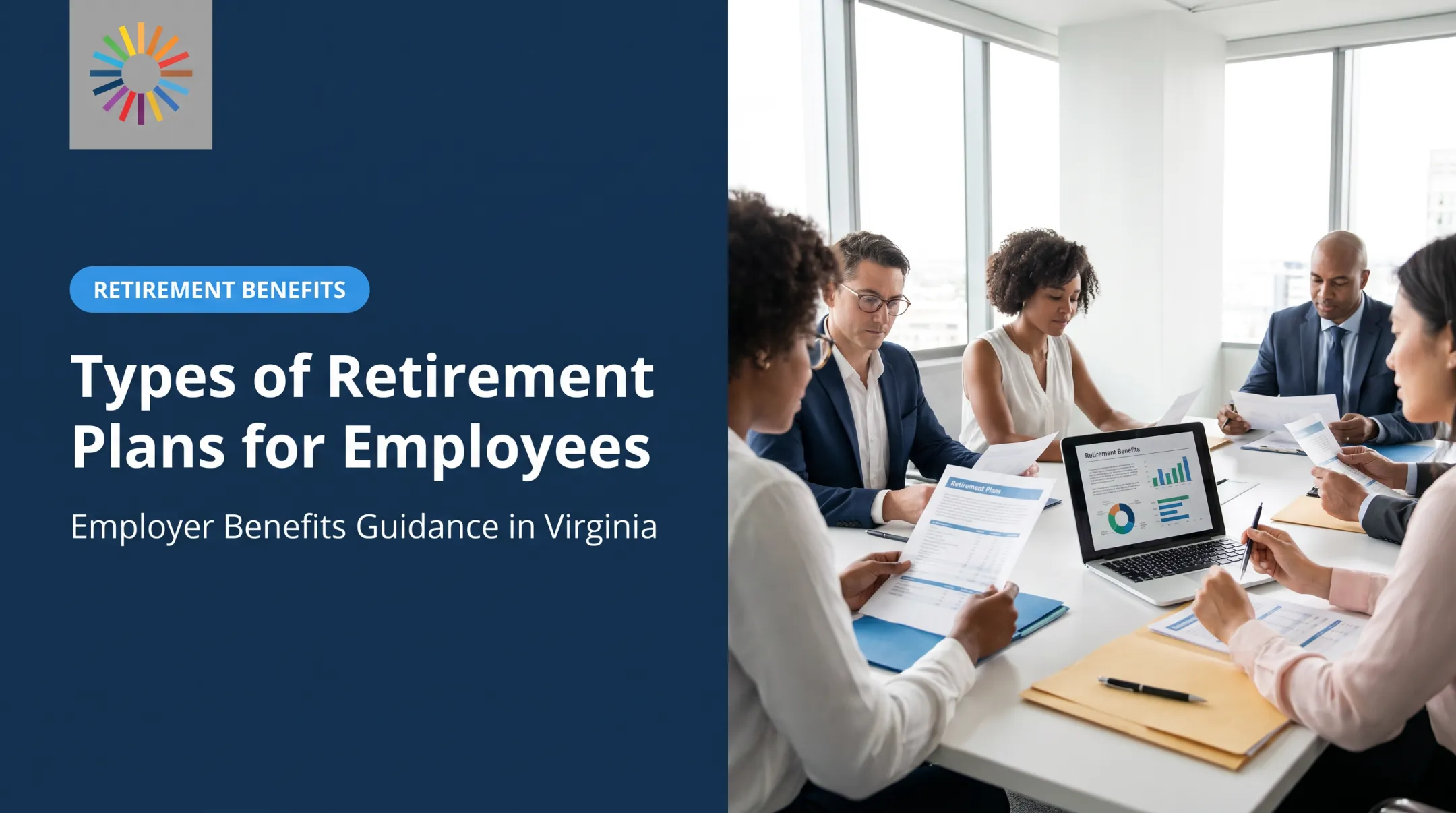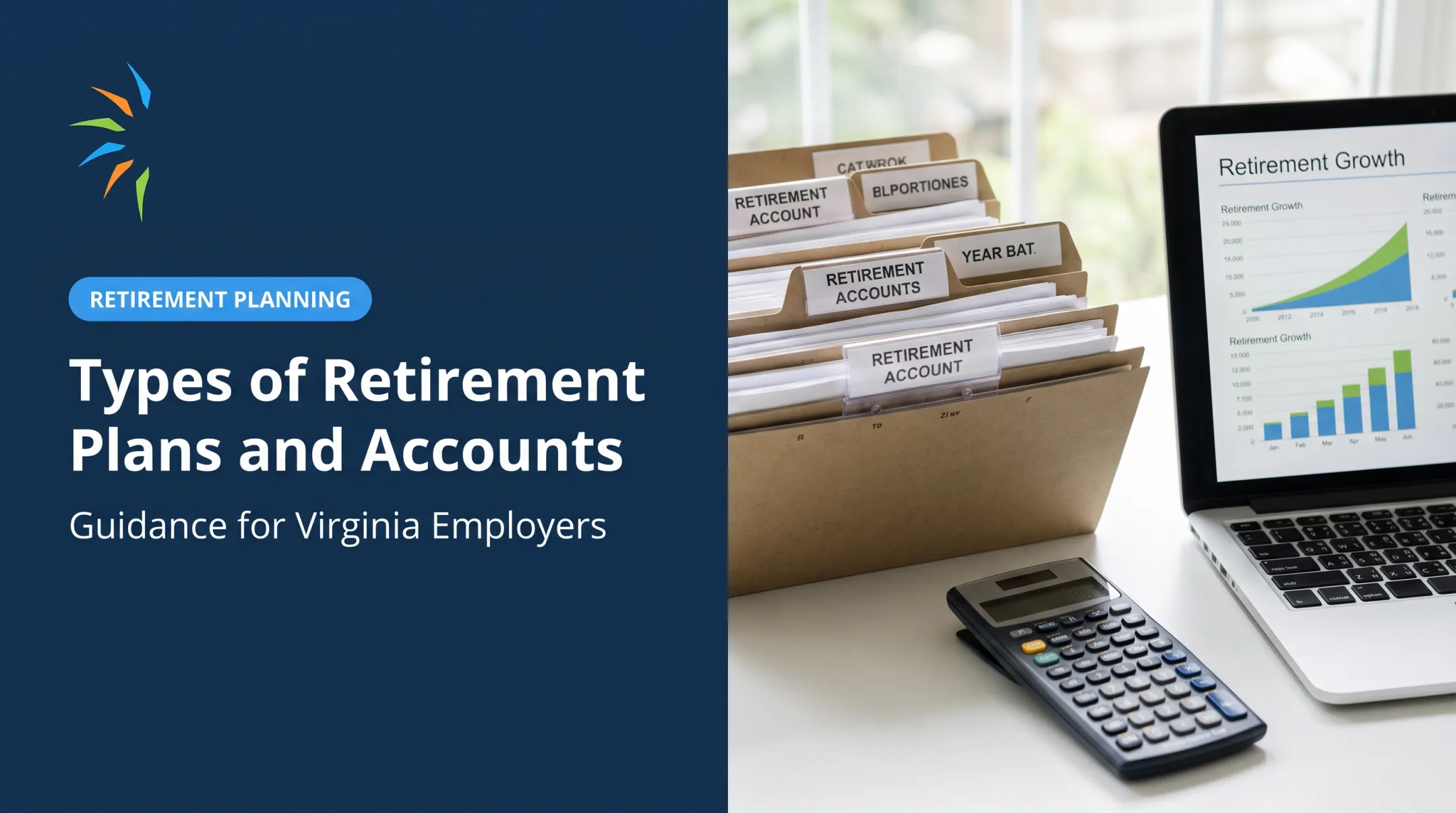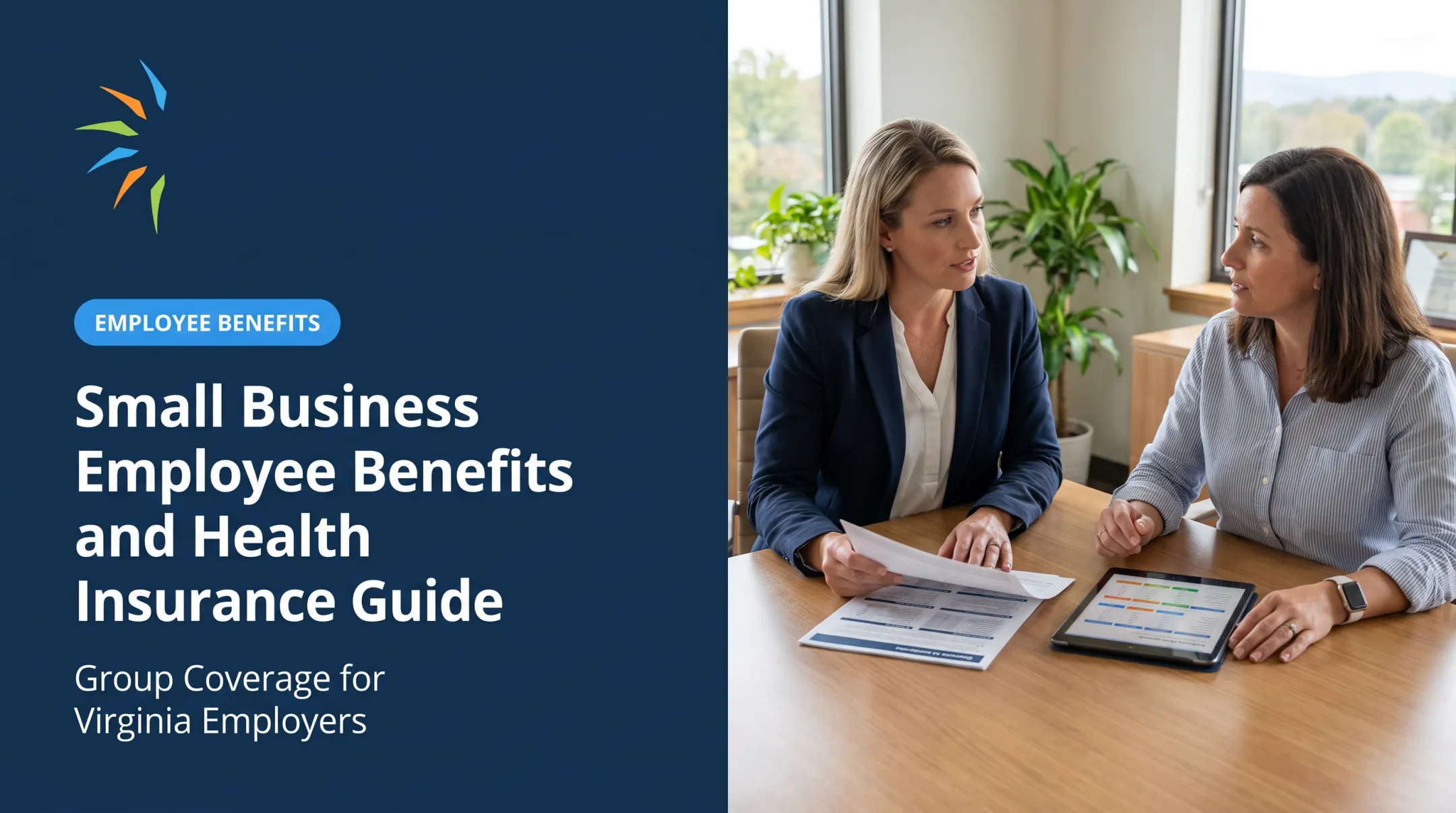

There's also a competitive reason to pay attention. Retirement benefits matter to workers: 62% of employees said retirement plans contribute to their financial security in 2024, up from 56% the year before, according to PLANADVISER's 2024 report. In a tight labor market, that's a recruiting edge you can't ignore.
Muneris Benefits has guided Virginia and West Virginia employers through benefits decisions since 1990. This guide covers plan types, setup steps, costs, employer matching, and the 2026 rule changes you need to know.
Key Takeaways
- Small business 401(k) setup typically takes 30-60 days from decision to launch
- Plan options (Traditional, Safe Harbor, SIMPLE, Solo) fit different business sizes and budgets
- Tax credits can offset much of the startup and administrative cost for eligible employers
- Employer matching is optional in most designs but strongly influences participation
- 2026 brings updated contribution limits and expanded catch-up rules
Should Small Businesses Offer a 401(k)?
The recruiting math is straightforward. Small-business plan participation sat at 59% in 2024, well below the 82% seen at large companies. Add automatic enrollment, and that figure jumps to 81%, according to Vanguard's 2025 small-business retirement report.
Employees want the benefit. They just need a plan designed to nudge them in.
Tax credits make this far cheaper than most owners expect. Under SECURE 2.0, eligible small employers can claim:
- Startup cost credit: 100% of qualified costs for 1–50 employees (50% for 51–100), up to $5,000 for three years
- Auto-enrollment credit: $500 per year for three years when the plan uses automatic enrollment
- Employer-contribution credit: Up to $1,000 per employee for five years (phases from 100% to 25%)

A Common Misconception
Many owners believe 401(k)s only make sense for companies with 50+ employees. That's not accurate. Solo 401(k)s exist specifically for self-employed individuals and owner-only businesses, and SIMPLE 401(k)s were built for companies with 100 or fewer employees. Size isn't the barrier it used to be.
Muneris Benefits' account managers help employers weigh these tax advantages against administrative responsibilities. The right plan depends on your payroll size, budget, and appetite for compliance work.
Which 401(k) Plan Is Best for Small Businesses?
There's no single "best" plan. The right fit depends on your headcount, budget, and how much administrative work you want to take on. Most small businesses land on one of four options: Traditional, Safe Harbor, SIMPLE, or Solo 401(k).
Traditional 401(k)
Offers the most flexibility. Employees make pre-tax payroll deferrals, and employer contributions are optional. The tradeoff is annual nondiscrimination testing (ADP/ACP). Low participation among staff can limit how much highly compensated employees or owners contribute.
Safe Harbor 401(k)
Requires the employer to make contributions, but those contributions are immediately, fully vested. In exchange, the plan is exempt from the nondiscrimination testing that trips up Traditional plans. This trade — guaranteed cost for simplified compliance — appeals to owners who want predictability.
SIMPLE 401(k) / SIMPLE IRA
Built for businesses with 100 or fewer employees. Administration is lighter, but the employer must provide either a 3% match or a 2% non-elective contribution. Contributions vest immediately, and the plan skips standard nondiscrimination rules entirely.
Solo/Owner-Only 401(k)
Designed for self-employed individuals or owner-only businesses with no other employees. It's technically a Traditional 401(k), not a separate plan type, but it lets the owner contribute as both employee and employer. That dual role often allows higher total savings than an IRA alone.
Quick comparison:
| Plan Type | Best For | Employer Contribution | Testing | Employee Limit |
|---|---|---|---|---|
| Traditional | Growing companies wanting flexibility | Optional | ADP/ACP required | No specific cap |
| Safe Harbor | Owners who want to skip testing | Required, fully vested | Exempt | No specific cap |
| SIMPLE | Businesses under 100 employees | Required (3% match or 2% flat) | Exempt | 100 or fewer |
| Solo | Owner-only or self-employed | Owner's choice, both roles | Generally N/A | Owner only (no common-law employees) |

Match the plan to your headcount, contribution budget, and tolerance for testing. If you want maximum flexibility and can manage compliance, start with Traditional. If you prefer predictable cost and less testing, Safe Harbor or SIMPLE usually fits better.
How Does a Small Business Set Up a 401(k)?
Setup generally runs 30-60 days, according to Paychex, and follows a predictable sequence:
- Research providers and set eligibility rules. Decide on age and service requirements (the IRS default is age 21 with one year of service) and how enrollment will work.
- Choose your plan structure: Traditional, Safe Harbor, SIMPLE, or Solo — based on the comparison above.
- Obtain a plan document and Summary Plan Description (SPD). This spells out eligibility, contributions, vesting, and withdrawal rules. Employees must receive the SPD within 90 days of becoming a participant.
- Establish a trust with a designated trustee to hold and manage plan assets. This is a legal requirement, not optional paperwork.
- Set up recordkeeping and understand fiduciary duties, including annual Form 5500 filing (due the last day of the seventh month after the plan year ends, typically July 31 for calendar-year plans).
- Communicate the plan to employees through the SPD and ongoing updates, plus quarterly or annual benefit statements when participants direct their own investments.

That last step is where ongoing support matters most. Muneris Benefits' employee benefits account managers help employers with day-to-day communication and administration after launch. That includes answering employee questions, coordinating with carriers, and resolving billing or documentation issues.
How Much Does It Cost to Set Up and Maintain a 401(k)?
Costs generally fall into four buckets:
- Setup/document fees — one-time charges for establishing the plan
- Administrative fees — recordkeeping, accounting, legal, and trustee services, either billed to the employer or deducted from plan assets
- Investment fees — typically a percentage of assets, paid by participants through fund expense ratios
- Individual-service fees — charges for specific features like plan loans, paid only by the employees who use them
Your total cost depends heavily on plan design. A SIMPLE plan skips the nondiscrimination testing that adds cost to a Traditional plan. A Safe Harbor plan trades a guaranteed employer contribution for lower administrative complexity.
Eligible small employers can offset much of this expense through the startup, auto-enrollment, and contribution tax credits outlined above, available for the first three years in most cases. These are credits against your tax bill, not a guaranteed cash reimbursement, so confirm eligibility with your tax advisor before budgeting around them.
Understanding Employer Contributions and Matching
Employer contributions are optional under Traditional 401(k) plans but required under Safe Harbor and SIMPLE designs. Common structures include:
- Partial match — for example, 50 cents per dollar on the first 6% of pay (a common formula, used by 13% of plans)
- Dollar-for-dollar match — full match up to a set percentage of pay
- Non-elective contribution — a flat percentage contributed regardless of employee deferrals
Is a 4% Match Competitive?
Vanguard's 2025 How America Saves report puts the average promised employer match at 4.6% of pay, with a median of 4.0%. A 4% match lands at the median, so it is competitive for most small businesses.
Vesting Schedules and Employee Ownership
Vesting determines when employees actually own employer contributions:
- Immediate vesting — employees own contributions right away
- Cliff vesting — 100% ownership after a set period, often three years
- Graded vesting — ownership increases gradually over several years

Safe Harbor and SIMPLE plan contributions are always fully vested immediately. Traditional plans give employers more flexibility on vesting, which can encourage employees to stay longer before they fully own the match.
Frequently Asked Questions
How much does it cost to set up a 401(k) for a small business?
Costs vary by provider, plan type, and business size, covering setup, administration, and investment fees. SECURE 2.0 tax credits can offset much of the initial expense for eligible small employers over the first three years.
How does a small business offer a 401(k)?
Select a plan type and provider, adopt a formal plan document, establish a trust, and share a Summary Plan Description with employees. Most setups take 30-60 days.
How long do you have to work at a company to get a 401(k)?
The IRS default eligibility rule is age 21 with one year of service, but employers can set more lenient terms. Some allow immediate eligibility to attract talent faster.
Can a small business owner have a 401(k)?
Yes. Solo (owner-only) 401(k) plans let self-employed individuals or owner-only businesses contribute as both employee and employer, often allowing higher savings than an IRA.
Is a 4% company match good for a 401(k)?
Yes. It sits right around the national average (4.6%) and median (4.0%) reported by Vanguard, making it a solid, competitive offering for most small businesses.
What is the new 401(k) rule for 2026?
The elective deferral limit rises to $24,500, standard catch-up contributions increase to $8,000, and workers aged 60-63 get a higher $11,250 catch-up limit. High earners over $150,000 in prior-year wages must make catch-up contributions on a Roth basis. Consult a benefits advisor to confirm how these apply to your plan.
Navigating plan types, tax credits, and compliance requirements takes time most small business owners don't have. Muneris Benefits' account managers work with Virginia and West Virginia employers to weigh these decisions as part of a broader benefits strategy. Reach out to discuss your options.